
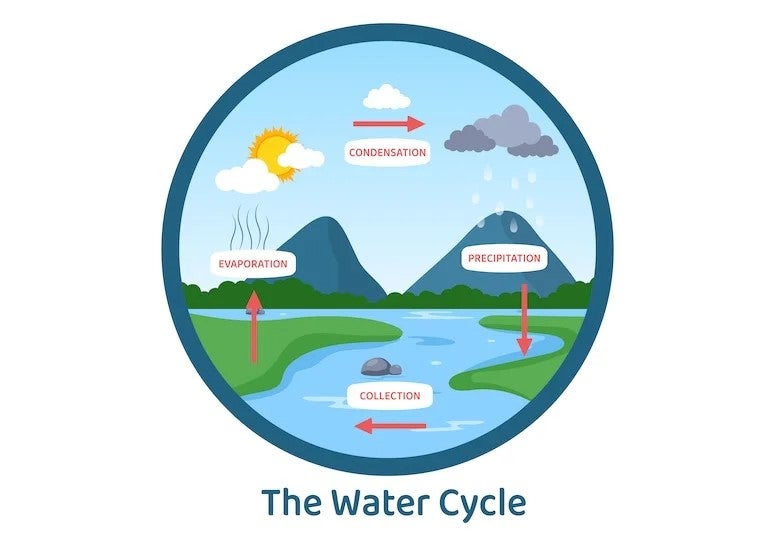
An international research team, including scientists from Rice University, the University of Tokyo and NASA, has completed the first fully standardized comparison of isotope-enabled climate models. In a recent study published in ESS Open Archive, the researchers showed that multimodel ensemble provides the most accurate representation of the present-day global water cycle.
“This work is about expanding our scientific community’s ability to study the water cycle across space and time,” said Sylvia Dee, associate professor of Earth, environmental and planetary sciences at Rice and one of the project’s lead principal investigators. “This collaboration is helping us to understand water’s unique fingerprints as it moves through the climate system. We can see changes in Earth’s water cycle with anthropogenic warming through a new lens and refine our future projections of water-related extreme weather events.”
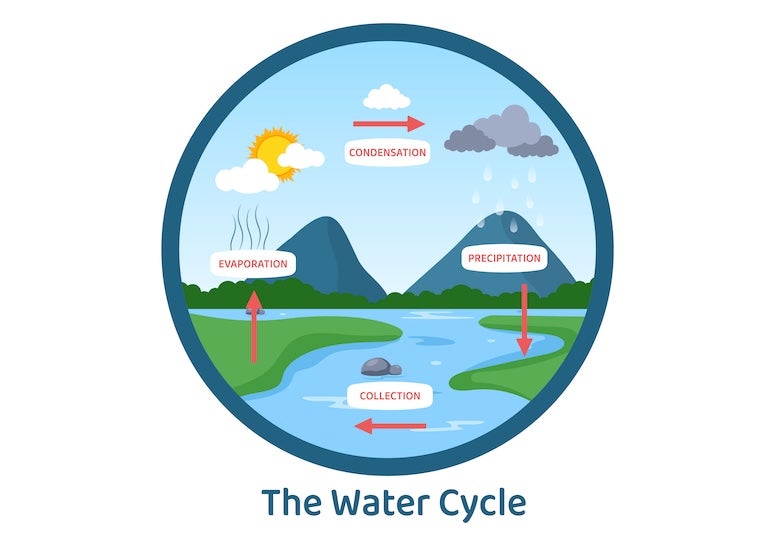
Water isotopes — molecules of water containing heavier forms of hydrogen and oxygen — are powerful tracers of atmospheric moisture transport and phase changes. Over the past two decades, isotope-enabled climate models have been developed independently by multiple research groups worldwide. However, differences in experimental design and boundary conditions have made it difficult to directly compare their performance and to assess the robustness of simulated isotope distributions.
To address this challenge, the research team conducted the Water Isotope Model Intercomparison Project (WisoMIP). In this project, eight state-of-the-art isotope-enabled climate models were forced with identical atmospheric circulation fields derived from the ERA5 reanalysis together with unified sea surface temperature and sea ice conditions. The models simulated the three-dimensional distribution of atmospheric water isotopes on a daily basis from 1979 to 2023, enabling a direct comparison of isotope processes while controlling for large-scale atmospheric circulation.
“By comparing isotope-enabled climate models under fully unified conditions for the first time, we demonstrate the robustness and added value of the multimodel approach for tracing Earth’s water cycle,” said Hayoung Bong, first author and postdoctoral fellow at the NASA Goddard Institute for Space Studies. “At the same time, the spatial patterns of model spread highlight where further model development and observations are most needed.”
The results show that, although individual models exhibit regionally varying biases, the multimodel ensemble mean consistently outperforms any single model in reproducing observed isotope distributions in precipitation, water vapor and snow. In addition, the ensemble reproduces the expected large-scale spatial structure of precipitation oxygen isotopes, while revealing where intermodel uncertainty remains large. Together, these results demonstrate both the robustness and the limitations of current isotope-enabled climate models.
Because water isotope signals are preserved in natural archives such as ice cores, corals and tree rings — and can now be directly observed in precipitation and atmospheric water vapor — these findings provide a critical link between modern observations, paleoclimate reconstructions and future climate projections. The WisoMIP dataset establishes a new international benchmark for evaluating isotope-enabled climate models and is expected to contribute to reducing uncertainty in climate change assessments.
This research was supported by the Japan Society for the Promotion of Science; Japan’s Ministry of Education, Culture, Sports, Science and Technology; the Japan Science and Technology Agency; the Environmental Restoration and Conservation Agency; the Arctic Challenge for Sustainability Phase III; the Research Council of Norway through the iTRANSFER project; and the U.S. National Science Foundation.
Rachel Leeson - Feb. 13, 2026
POSTED IN: RICE NEWS > Current News > 2026